

Table of Contents
An employee’s cell phone rings, and the caller ID shows it’s coming from inside the organization. The person on the line introduces themselves as a member of the security team, including a legitimate name, email address and employee identification number.
“You’ve been caught in a breach and hackers are trying to use your password on our systems right now,” the imposter says, “and I need you to change your password via the link I’m emailing you.”
The employee responds to the urgency of the seemingly legitimate request and ends up entering their credentials and MFA into a lookalike webpage. Now their credentials are actually compromised.
That’s a help desk impersonation attack, and it’s spreading fast because AI made it absurdly cheap to run.
Key Takeaways
- Help desk impersonation works because AI can research an employee’s identity, role, and reporting line in minutes, then write a convincing script around it.
- 65% of AI-involved breaches now target people and their identities (Verizon DBIR 2026); phone-based intrusions doubled in the first half of 2026 after rising 134% the year before (CrowdStrike).
- Email security, endpoint protection, and firewalls are all blind to a phone call, which is why these attacks often surface only after the fact.
- VanishID’s External Identity Protection scores risk per employee in real time and fires countermeasures across six classes before a call can succeed.
Why Employees Pick Up and Comply
When a call comes in from a known help desk number with an urgent technical problem and confirms personal details about the employee, even suspicious employees can be disarmed. Now that the reconnaissance, calling and voice interactions that drive these attacks can be automated entirely by AI, highly targeted attacks like this can happen concurrently at scale.
Researching one target used to take a skilled person days. Now, before the phone even rings, AI-powered reconnaissance has already pulled the employee’s personal cell number, job title, manager’s name, ID number, and spot on the org chart, sometimes even the company’s own password-reset instructions, stitched together from old data breaches, social media profiles, and the sites built to collect and resell exposed identity data. Many employees will have sufficient exposure to enable this attack, and each one of them can receive a call simultaneously, from a familiar (cloned) voice, without touching the enterprise firewall.
Verizon’s 2026 Data Breach Investigations Report found that 65% of breaches involving AI targeted people and their identities, nearly double the rate across breaches overall.
Phone-Based Attacks Are Climbing, and the Numbers Show It
CrowdStrike’s 2026 Threat Hunting Report found that intrusions starting with a phone call doubled in the first half of 2026, after jumping 134% the year before. Verizon’s DBIR puts a number on the shift away from email, too: 41% of attacks that trick a person into acting now arrive through some channel other than email. In financial services, CrowdStrike tracked a group it calls MUTANT SPIDER driving the highest intrusion volume through vishing, the industry term for phone-based social engineering, then selling that access to ransomware operators.
The pattern behind these numbers is consistent. Attackers have learned that a convincing phone call beats a phishing email on almost every metric that matters to them: it’s harder to filter, harder to train employees against in a single sitting, and it exploits a habit most companies actively encourage, which is helping a coworker who sounds stuck.
Your Security Stack Wasn’t Design To Watch This Door
The tools most companies already run weren’t built to catch this. Email security never sees the call, because it isn’t email, and endpoint protection doesn’t do much better, since the call never touches a company laptop. The firewall misses the whole thing too, since it never crosses the corporate network in the first place. Most security teams find out after the fact, when the logs show what looks like an employee doing ordinary work.
This is the gap external identity security exists to close: mitigating the attack risk that exposed identity information creates before attackers use it, not waiting for the call to show up in a log. Multi-factor authentication helps, but it only goes so far. A pushed sign-in approval or a read-back code defeats MFA cleanly, because the employee completes the second factor themselves, believing they’re helping IT fix a real problem. The authentication method holds up fine. What gives way is the employee’s confidence that the caller is who they claim to be, and that confidence comes from the attacker already having enough real information to make the request sound routine.
How External Identity Protection Breaks the Chain
VanishID’s platform starts working before the phone ever rings. It continuously scans the same places attackers (and their AI tools) look for exposed identity data about an employee. When something new turns up, it updates that employee’s risk score, and the system calculates whether a help desk impersonation call, or any other social engineering or credential abuse attack, could succeed against that specific person right now. When the answer is yes, a playbook fires on its own.
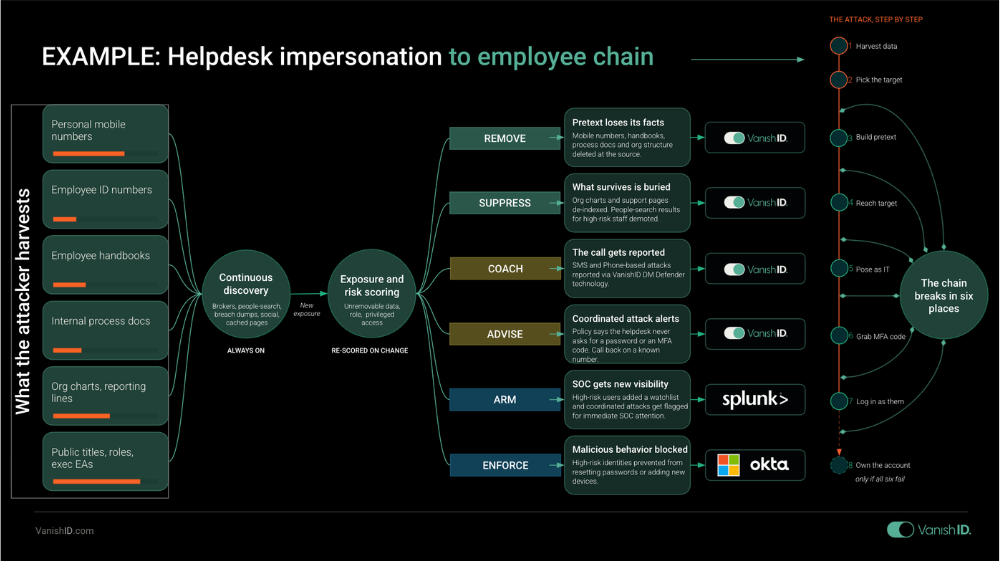
Hundreds of countermeasures sit behind that playbook, sorted into six classes, and each one runs inside a tool the security team already has open:
- ENFORCE auto-triggers compensating technical controls.
- ARM puts exposure context inside the tools the team already watches.
- ADVISE turns risk into security process guidance.
- COACH delivers targeted training at the moment it matters most.
- SUPPRESS hides what cannot be deleted.
- REMOVE deletes exposed records where possible.
ENFORCE auto-triggers compensating technical controls. When an employee’s exposure crosses the line where a help desk call could succeed, VanishID calls your existing stack through its APIs and fires the control(s) that closes part of the path: a forced reset on a work password that’s showing up reused in a breach, a session revoke, an MFA step-up on that account, a lock on remote identity changes inside the IdP, device isolation, or rotation of a leaked secret. No ticket gets opened and no analyst makes a call. The control(s) runs because the risk score said it should.
ARM puts exposure context inside the tools the team already watches. The verification questions a help desk asks (employee ID, date of birth, home address, manager’s name) are only useful if the answers are secret. Once they’ve leaked, they’re burnt. ARM pushes that fact into the tools where it changes behavior: the exposed employee lands on a SIEM watchlist, their leaked employee ID gets flagged to the ITSM for rotation, and the help desk sees that this person’s DOB and address are public, so a caller reciting them proves nothing. The same alert that looked like routine activity yesterday now carries the context to read it as an attack.
ADVISE turns risk into security process guidance. Some of the fix is policy, not technology. If a large share of your workforce has exposed verification data, a help desk process that resets MFA on a phone call is a process built for a world that no longer exists. ADVISE gives the security team the specific, risk-ranked recommendation: require an out-of-band callback to a number on file before any MFA reset, retire DOB and address as verification attributes, add a manager confirmation step for privileged accounts. Each one is tied to the exposure that makes it necessary, so it reads as a finding with a reason attached.
COACH delivers targeted employee training at the moment it matters most. Annual awareness training teaches everyone the same thing on the same day. COACH sends the one employee whose exposure just went up a short, specific nudge about the habit that caused it: the travel plans posted publicly that tell an attacker when the manager will be unreachable, the reused password, the personal mobile listed on a public profile. It arrives when the risk is real for that person, which is the only time anyone changes a habit.
SUPPRESS hides what cannot be deleted. Some records never come down. A property deed, a business filing, a personal mobile number sitting in a decade-old breach. VanishID de-indexes and demotes those from search so an AI running reconnaissance on your staff list doesn’t find them in the first pass. The record still exists somewhere. It just stops being three keystrokes away.
REMOVE deletes exposed records where possible. The caller knew the year they bought their house, and the name of the kid who plays travel soccer on Saturdays, and none of it took any skill to find. That is what a data broker profile looks like when an AI reads it: relatives, past employers, old phone numbers, voter registration, a court filing from a decade ago, all cross-linked to a work email. VanishID files the removal with each source, verifies the record came down, and refiles the moment it resurfaces, because brokers repopulate. Take the detail away and the caller is left reciting a job title anyone could read off LinkedIn.
Employees get a way to check, too. If a call feels off, they text a screenshot of the number to VanishID and get an automated verification answer back in seconds.
The playbook decides which of those six to fire and how hard to lean on each one. And the mix keeps adjusting as a person changes roles, as new exposure turns up, or as a removal that held for six months quietly fails.
“This call works because everything the attacker needs to sound real is already published somewhere, and AI made assembling it nearly free. That changed the math in the attacker’s favor. Our countermeasters even the playing field. By the time the call reaches your employee, the countermeasures that break this attack have already fired, automatically, without a ticket, an analyst or a decision.”
— Matt Polak, VanishID CEO
One Attack in a Bigger Family
Help desk impersonation doesn’t operate alone. It’s one branch of a wider set of attacks that all draw on the same raw material: whatever is knowable about your people. That family includes social engineering more broadly, a fake call, an email built from an employee’s own real details, a cloned voice on a video call, along with credential abuse, where passwords and login codes stolen in some other breach get tried against company accounts. The countermeasures that stop one don’t automatically stop another, which is why VanishID built this playbook specifically for the call instead of treating it as a variant of something else.
What This Means for Your Team Right Now
The help desk impersonation playbook is live now for every External Identity Protection customer. There’s no software to install, and employees don’t have to change anything about how they work. Getting an employee covered takes a name and a work email address.
For a company that wants to see this in action before committing to anything, VanishID’s AI Exploitability Analysis is free. Name an employee, and it ranks which AI-fueled social engineering and credential abuse attacks are most likely to work against that specific person, shows how an attacker would use AI to turn them into a way into the business, and lists the exact countermeasures VanishID would fire to stop each one.