

Threats to your systems don’t just come from outside attackers. Some of the most damaging breaches start from within. Internal cybersecurity threats, both intentional and accidental, often go unnoticed for longer and can be just as disruptive as external attacks.
That’s why businesses need a clear strategy that addresses both types of risk. This post looks at the difference between external and internal cybersecurity threats, gives real-world examples, and shares practical steps for identifying and defending against each one.
Key Takeaways
- External threats come from outside actors like cybercriminals, hacktivists, or state-sponsored groups and include phishing, ransomware, and DDoS attacks.
- Internal threats originate from employees, contractors, or vendors and may involve stolen credentials, accidental sharing, or misconfigurations.
- Insider threats are often harder to detect, especially when they involve privileged users or human error.
- External attacks typically move faster, while internal incidents can stay hidden longer and cause deeper damage.
- Both threat types can impact data security, system uptime, financial health, and brand reputation.
- Defenses must include firewalls, PAM tools, threat intelligence, insider threat programs, and ongoing employee training.
- A unified approach to cybersecurity should include zero-trust architecture, executive buy-in, and cross-department support.
What Are External Cybersecurity Threats?

External cybersecurity threats are attacks that come from outside an organization’s network perimeter. They’re typically launched by malicious third parties with no authorized access, including cybercriminals, hacktivists, and state-sponsored groups.
Their goal can either be to steal data, disrupt operations, extort money, or simply cause reputational harm.
Unlike insider threats, these attackers work without internal credentials or system privileges. They rely on technical exploits, social engineering, or brute force to gain access and move through systems.
Here are the most common types of external threats businesses face:
Phishing Campaigns
These involve emails, messages, or fake websites designed to trick employees into revealing login details, downloading malware, or sending sensitive data. Phishing remains one of the most effective entry points for attackers because it targets human behavior, not just systems.
Ransomware and Malware Attacks
Malware is malicious software that’s installed on a device or network without the user’s knowledge. Ransomware, one of the most damaging forms, encrypts files and demands payment to unlock them. These attacks are often distributed through phishing emails or compromised websites.
DDoS (Distributed Denial-of-Service) Attacks
DDoS attacks flood an organization’s servers or websites with overwhelming traffic from multiple sources. The goal is to knock systems offline, disrupt access, or create a distraction while another breach takes place.
State-Sponsored or Organized Cybercrime Groups
Some threat actors are part of larger operations backed by governments or criminal organizations. These groups often target enterprises with sensitive data, valuable IP, or critical infrastructure. Their tactics are advanced and persistent, making them harder to detect and stop.
What Are Internal Cybersecurity Threats?

Internal cybersecurity threats originate from individuals or systems that already have access to an organization’s internal environment. These include current or former employees, contractors, third-party vendors, and even compromised internal accounts.
Unlike external attacks, these threats don’t need to bypass firewalls since they already operate behind them. They can stem from human error, misuse of access, or intentional abuse of trust.
Some are malicious; others are purely accidental. But all of them carry serious risk, particularly when sensitive systems or data are involved.
Below are the most common types of internal threats:
Malicious Insiders
These are individuals who intentionally misuse their access to steal data, sabotage systems, or leak sensitive information. They may act out of revenge, financial gain, or ideological motives. In some cases, malicious insiders are recruited or bribed by external threat actors.
Accidental Insiders
Not all insider threats are intentional. Employees might click on phishing links, misconfigure security settings, send files to the wrong recipient, or fall for social engineering tactics. Even well-meaning staff can expose the organization to serious risk through simple mistakes.
Third-Party Vendors with Access
Partners, contractors, or service providers who are granted network access can also become an attack vector. If their systems are compromised or their employees act carelessly, that risk extends into your environment.
Comparing Internal and External Cybersecurity Threats
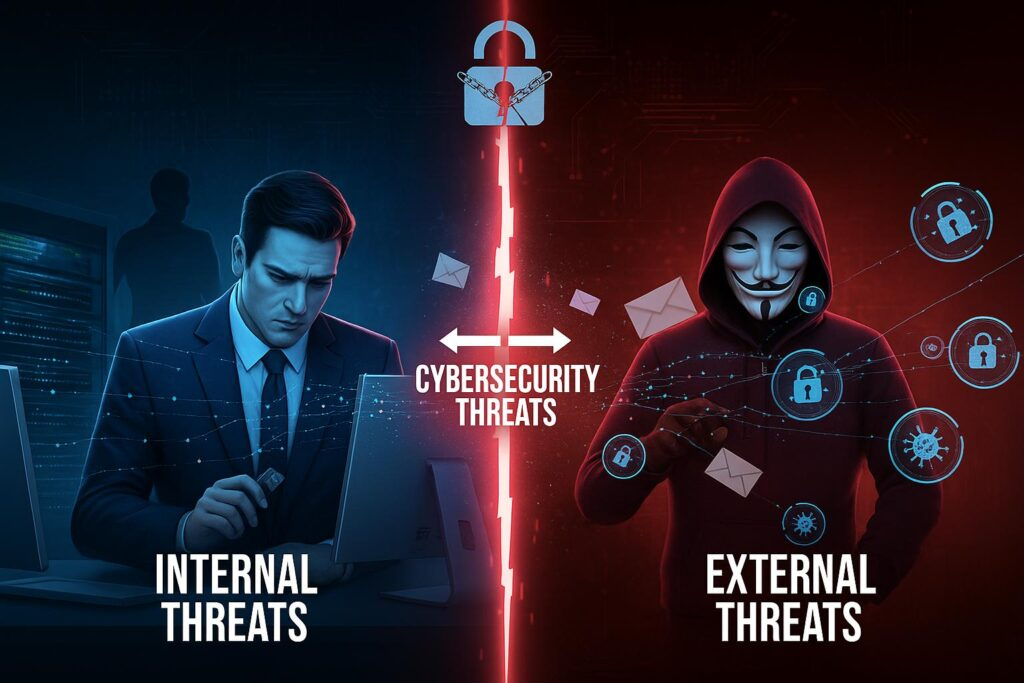
Both internal and external threats expose organizations to serious risks, but they differ in how they originate, how they’re detected, and the kind of damage they can cause. Understanding the difference can help determine the right defenses.
Here’s a side-by-side comparison to highlight what sets them apart:
Internal vs. External Threats: Quick Breakdown
| Category | Internal Threats | External Threats |
| Source | Employees, vendors, contractors, and insiders with system access | Cybercriminals, state actors, hacktivists, and external attackers |
| Intent | Malicious or accidental | Typically malicious |
| Attack Methods | Data theft, privilege misuse, and misconfigurations | Phishing, malware, DDoS, credential stuffing |
| Detection Difficulty | Often harder to detect due to trusted access | Usually faster to trigger alerts once the perimeter is breached |
| Response Time | Slow, often detected after damage is done | Faster. Response kicks in after alerts or disruptions |
| Example Impacts | Leaked IP, financial fraud, sabotage, compliance issues | System downtime, data breaches, ransomware, public exposure |
Internal threats tend to be more subtle and long-term. They may take months to detect if they involve someone with privileged access or involve accidental errors. The cost of these incidents can be higher because they often involve sensitive data and compliance violations.
External threats, on the other hand, move fast. Once a firewall is breached or malware spreads, the impact is immediate and loud. These attacks are easier to spot, but they also happen at a much larger scale.
Common Physical Threats to Information Security
Cybersecurity strategies often focus on software, firewalls, and user credentials; however, physical security is just as important. When attackers gain access to devices, rooms, or printed information, the fallout can be just as severe as a digital breach.
So if you’re asking what are some physical threats to your information security, here are the most common ones to watch for:
Stolen or Lost Devices
Unsecured laptops, mobile phones, or USB drives can become easy entry points into your network. If they’re lost or stolen without encryption or proper access controls, attackers may be able to retrieve emails, passwords, or even sensitive internal data.
Unauthorized Access to Restricted Areas
Someone walking into a server room or employee workspace without clearance can install rogue devices, steal hardware, or plug into exposed ports. Without physical security measures like access logs or cameras, these breaches often go unnoticed.
Badge Cloning and Tailgating
Cybercriminals may clone ID badges or follow staff into restricted areas (tailgating). Once inside, they can exploit open systems, unattended devices, or gain information for future attacks.
Poor Disposal Practices
Hard drives, printouts, and even sticky notes with login info can expose confidential data if not properly destroyed. Physical documents should be shredded, and digital devices wiped or degaussed before disposal.
Tools and Strategies for Defending Against Both
To reduce risk across the board, organizations need layered defenses that cover both internal and external cybersecurity threats. This means using the right mix of technology, policy, and people, not just locking down the network perimeter.
Here’s how to strengthen your security posture on both fronts:
External Threat Defense Tools
These tools protect networks from external threats by monitoring activity, blocking intrusions, and reducing exposure to known attack methods:
- Firewalls – Act as the first line of defense, filtering traffic and blocking known malicious activity before it reaches internal systems.
- Endpoint Security – Protects devices like laptops, servers, and mobile phones with antivirus, threat detection, and response capabilities.
- Intrusion Detection and Prevention Systems (IDPS) – Identify suspicious behavior and stop breaches in real-time.
- Threat Intelligence Feeds – Offer insight into known attack patterns, emerging threats, and vulnerabilities so teams can stay ahead.
- Email Security Platforms – Help catch phishing emails, malicious links, and spoofed senders before users engage.
Internal Threat Defense Strategies
Internal threats often require more granular controls and proactive monitoring. These tools and processes help reduce risk from within:
- Privileged Access Management (PAM) – Limits high-level access to only those who need it, with session tracking and automatic expiration.
- Zero Trust Architecture – Verifies every user and device, regardless of their location or prior access level.
- Insider Threat Programs – Combine behavior analytics with HR/legal coordination to flag unusual or high-risk activity early.
- Security Awareness Training – Educates employees on phishing, social engineering, data handling, and reporting procedures.
- Third-Party Risk Management – Assesses vendor access and security posture to avoid weak links in your supply chain.
Executive Takeaways: Building a Unified Security Posture
To protect against internal and external threats fully, organizations need to treat both as part of a single mission‑critical strategy. Here’s how to bring that strategy into action:
- Adopt Layered Defenses – Use perimeter tools (firewalls, intrusion detection) for external threats and access controls (privileged access, monitoring) for insider threats. A tool like VanishID’s managed platform lets you reduce exposure across digital and physical surfaces.
- Extend Security Beyond Infrastructure – Many threats now begin with a person or a device rather than a malicious packet. VanishID’s “Digital Executive Protection” service covers executives and their families, continuously monitoring public data exposure and removing risk.
- Make Access Management Non‑Negotiable – With internal threats, controlling who has access and what they can do is just as important as detecting external intrusions. Zero‑trust architecture and insider threat programs should be standard.
- Involve Leadership and Cross‑Functional Teams – Threats that impact data, systems, or physical safety need coordination across security, HR, legal, operations, and executive leadership. A unified posture means every stakeholder knows their role.
- Use Monitoring and Intelligence Continuously – External threat actors evolve rapidly, and insider risk can build slowly. Choose solutions, like VanishID’s agentic AI‑powered platform, that automate monitoring of exposed data and human attack surfaces so the security team is proactive, not just reactive.
- Measure & Report Precisely – Leadership needs visibility into how threats are managed. Clear metrics on attack surface reduction, incident response times, and access violations build trust and enable investment prioritisation.
- Plan for Physical + Digital Risk – Physical threats (device theft, unauthorized area access, badge cloning) tie directly into digital exposure. A strong security posture recognises this overlap and integrates physical controls with cybersecurity.
Conclusion
Internal and external threats may come from different sources. But the impact is often the same: data loss, downtime, reputational damage, and business disruption. Organizations that take a unified approach to cybersecurity are more likely to prevent, detect, and recover from both.
Build your defenses before the next threat strikes. Strengthen your internal controls, close external gaps, and support your team with the right tools and strategies.
Explore VanishID’s cybersecurity solutions or schedule a private consultation to find the best approach for your organization.