Chloe Nordquist
Digital Content Growth Manager at VanishID
June 25, 2026
5 min read
Table of Contents
h2
The average eCrime breakout time, the gap between an attacker getting into a network and moving deeper into it, fell to 29 minutes in 2025, down from 48 minutes the year before. The fastest breakout CrowdStrike recorded was 27 seconds. Attacks from AI-enabled adversaries jumped 89% year over year. Those numbers come from the CrowdStrike 2026 Global Threat Report, and the conclusion behind them is blunt: AI is making the adversary faster.
Twenty-nine minutes. Most security tooling was built to feed information to a person, who reads it, adds context, and reacts. As Routh put it, “humans don’t work 24 hours a day. They take PTO time and they don’t react that quickly because they try to understand data.”
So if an attack finishes faster than a human can read the alert, what does that mean for how security actually gets done? Routh’s answer: the human-in-the-loop model is running out of road. The speed of the attacker, he said, is “making that obsolete.”
Key Takeaways
The average eCrime breakout time fell to 29 minutes in 2025, down from 48 the year before, with AI-enabled attacks up 89% year over year (CrowdStrike 2026 Global Threat Report).
Tooling built to feed alerts to a human now reacts too slowly for AI-speed attacks.
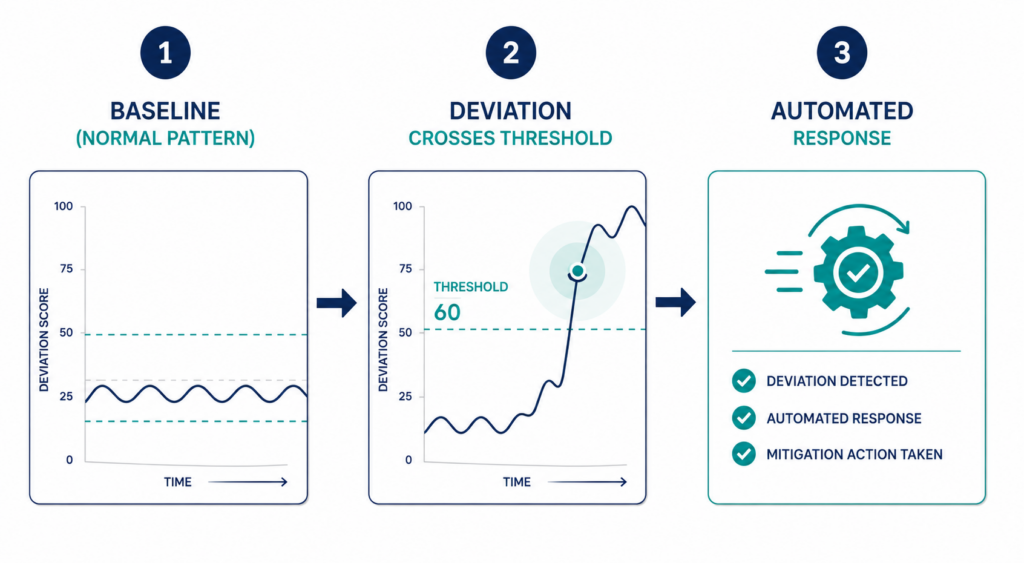
A digital immune system detects pattern deviation, crosses a numeric threshold, and fires an automated response with no analyst in the path.
Humans shift from triaging every alert to tuning thresholds and watching trends. Out of the critical path, still in the loop.
An executive’s and family’s digital footprint generates the signal these models need. A per-person risk score makes it actionable, and VanishID runs it continuously and at scale.
Borrowing the Body’s Playbook
Routh’s framing comes from biology. Your body doesn’t book a doctor’s appointment before it fights off an infection. It detects something foreign, produces antibodies, and neutralizes the threat. The person it’s protecting never decides any of it. That, Routh argues, is the model security needs now.
“A digital immune system is similar to the way the human body protects itself against bacteria and virus to where antibodies are created to attack both. And the whole immune system operates without a conscious decision of the person.”
— Jim Routh
How a Digital Immune System Actually Works
Strip the biology away and you get three moving parts: a baseline, a deviation, and a response. The system learns what normal looks like for a given person or asset, using whatever attributes it can measure, mostly online activity. When live data drifts past a set numerical threshold, that crossing fires an automated workflow. No analyst reads it first.
That is the core premise. In Routh’s words, “the best technology today regardless of the use case, is based on a premise that pattern deviation triggers a response.”
This is the part that makes it scale. “Math and computers do this really well, a lot better than people… they’re not in the critical path for the remediation work or the protection work.”
The human doesn’t disappear. They move. Instead of sitting in the path of every alert, the cyber professional steps back, watches trends, and tunes the system. Routh’s example: a trigger set at 74 gets reviewed, and “we’re going to move it up to 76, or we’re going to move it down to 61.” The person adjusts the threshold. The machine runs the response. They’re out of the critical path, still in the loop.
Notice what the system runs on: a single number that captures how exposed someone is. That’s the same idea behind the risk score VanishID assigns to every person it protects. A baseline you can measure, watch, and drive down.
Why This Matters Most for Executive Protection
This isn’t only a SOC story. It maps onto executive protection, and arguably fits it better. An executive’s digital footprint, plus their family’s, throws off exactly the kind of signal a pattern-deviation model needs: data broker listings, breach records, social activity, home address and property data.
Routh’s view is that the old wall between professional and personal exposure has fallen. “CISOs today and cyber security professionals have to recognize that there’s a broad and diverse digital footprint that goes into the calculus of the threat actor and has to also go into the calculus of the enterprise protector.”
Doing that monitoring by hand, for every executive and every family member, doesn’t scale. Automate it and you get something a security leader can act on:
“I like the concept of the immune system, because you now have for every single employee a risk score. And the risk score is based on empirical data about what their digital activity is and what that translates into in terms of an attack surface.”
— Jim Routh
From Concept to Working System
The system Routh describes, continuous, automated, humans out of the critical path, a risk score for each person, is what VanishID’s agentic AI already does for digital executive protection.
VanishID’s engine runs continuous reconnaissance across the public, deep, and dark web. It scores exposure and removes it, without waiting on a security team to triage. The reason that matters shows up in VanishID’s own research: 93% of US executives have their home address sitting on a data broker site, 100% turn up in at least one breach (43 on average), and each one carries about 11 master data broker profiles mapping family ties, addresses, and other exploitable detail. VanishID removes this fuel continuously and at scale.
And it does it with zero lift on the executive or their family. That’s the part Routh flagged as the easy sell: “the ability to fundamentally immediately change the attack surface by shrinking it for executives is really attractive. And to do that without a heavy lift or any kind of burden on the executives themselves, that’s a real plus. That’s kind of like a low friction, high impact kind of opportunity and that’d be hard to say no to. If I was a CSO today, it’d be hard to say no to that.”
The Clock Is Still Running
The attacks already run on automation. They finish before anyone clocks in, and half of them now lean on AI. A defense built around a person reading an alert was designed for a slower threat. The time it takes to launch an attack continues to decrease. A digital immune system is how protection keeps pace.
Written by
Chloe Nordquist
Digital Content Growth Manager at VanishID
Chloe is a former award-winning journalist that now focuses on content strategy and brand storytelling. She spent years reporting on the business and tech sectors.
VanishID Protection
Ready to Strengthen Your Digital Security?
Whether you're protecting executives, your workforce, or sensitive family assets, VanishID provides tailored solutions for your unique security needs.
We use cookies to understand how you use our site so we can make it better. Analytics help us fix bugs and create content you want. Marketing cookies show you relevant job opportunities and security insights.
Functional
Always active
Required for the site to work properly
Preferences
Remember your settings and choices
Statistics
Help us understand what content you find usefulThe technical storage or access that is used exclusively for anonymous statistical purposes. Without a subpoena, voluntary compliance on the part of your Internet Service Provider, or additional records from a third party, information stored or retrieved for this purpose alone cannot usually be used to identify you.
Marketing
Show you relevant job opportunities and security insights
We use cookies to understand how you use our site so we can make it better. Analytics help us fix bugs and create content you want. Marketing cookies show you relevant job opportunities and security insights.
Functional
Always active
Required for the site to work properly
Preferences
Remember your settings and choices
Statistics
Help us understand what content you find usefulThe technical storage or access that is used exclusively for anonymous statistical purposes. Without a subpoena, voluntary compliance on the part of your Internet Service Provider, or additional records from a third party, information stored or retrieved for this purpose alone cannot usually be used to identify you.
Marketing
Show you relevant job opportunities and security insights