

Table of Contents
In April 2026, two unrelated incidents landed within weeks of each other. A private Discord group talked its way into a restricted build of Anthropic’s Claude Mythos model through a third-party vendor, using leaked credentials and a guessed URL format. Around the same time, an attacker threw an incendiary device at OpenAI CEO Sam Altman’s home gate. He showed up at OpenAI’s headquarters an hour later carrying a document that listed other AI executives, investors, and board members, with addresses attached.
Neither attacker needed to hack anything. They needed a browser, a little patience, and, maybe, an AI subscription.
That’s the starting point for VanishID’s 2026 AI Leadership Exposure Report, a study of the external identity data exposure of 75 senior leaders across nine AI and frontier-technology companies. We used only open-source data, the kind available to anyone with a laptop and a few minutes. Every single leader in the study has an exposed identity footprint. None came back clean.
If external identity protection works anywhere, it should work for the people running the companies building artificial intelligence. It mostly doesn’t. Here are four findings from the report that explain why, and what they mean for every company whose leaders and employees carry the same exposure.
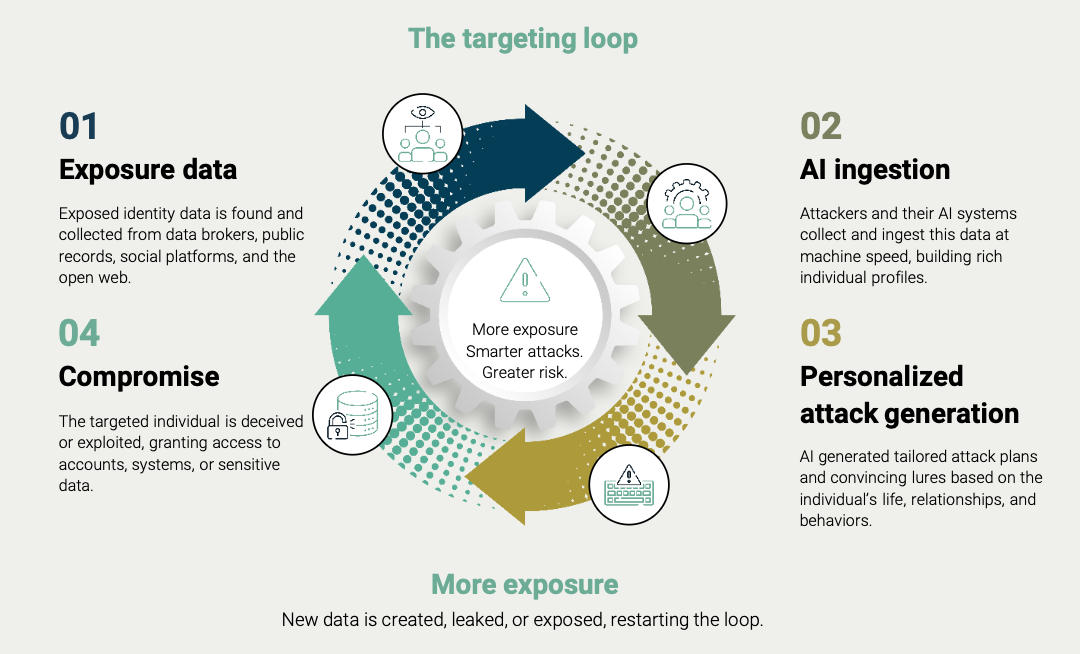
1. The Exposure Trio That Supports A SIM Swap
A date of birth. A personal phone number. A home address. Separately, each one is background noise on the open web. Tied to the same name, they’re the building blocks of a SIM swap. That’s the fraud technique where an attacker tricks or bribes a phone carrier into moving a victim’s number onto a SIM card the attacker controls.
VanishID found that combination findable for 87% of the leaders studied. 97% have a findable personal phone number on its own. 95% have a findable date of birth. 93% have a residential address on record. None of that required a breach or a hack. It came from consumer data brokers, public records, and the open web, the same sources a carrier’s fraud team would struggle to tell apart from a legitimate caller.
Carriers often add protections for high-profile customers, like a port freeze or a dedicated PIN, and a bare profile won’t get past those on its own. SIM-swap fraud still works often enough anyway, by talking a carrier representative into waiving those protections. The data in this report is what makes that call sound credible in the first place.
2. Families Carry The Same Exposure With Less Protection
A company can put executive protection around its CEO. It rarely extends that protection to the CEO’s spouse, parent, or child, and attackers know it.
The report found a findable spouse for 65% of the cohort, a findable parent for 60%, and a findable minor child for 39%. A profile that lists a spouse, a parent, and a shared address turns one search into a household map. A pretext call doesn’t have to go to the executive, either. It can go to the spouse, who has no security team, no phishing training, and no reason to be suspicious.
The 39% figure for minor children is the one worth sitting with. A child’s record tends to carry school, sports, and neighborhood detail. None of it sits under whatever protection the company purchased for the executive. Removal work is usually scoped to one individual, while data brokers keep rebuilding profiles from the relatives’ side. Protection scoped to one person is protection with a known way back in.
3. The Impersonation Fuel Sitting In Plain Sight
In 2024, a finance employee at the engineering firm Arup joined a video call where every other participant was fabricated, including a deepfaked CFO. He ended up sending roughly $25 million to the attackers. Reporting at the time said the attackers built those deepfakes from publicly available footage of the real executives.
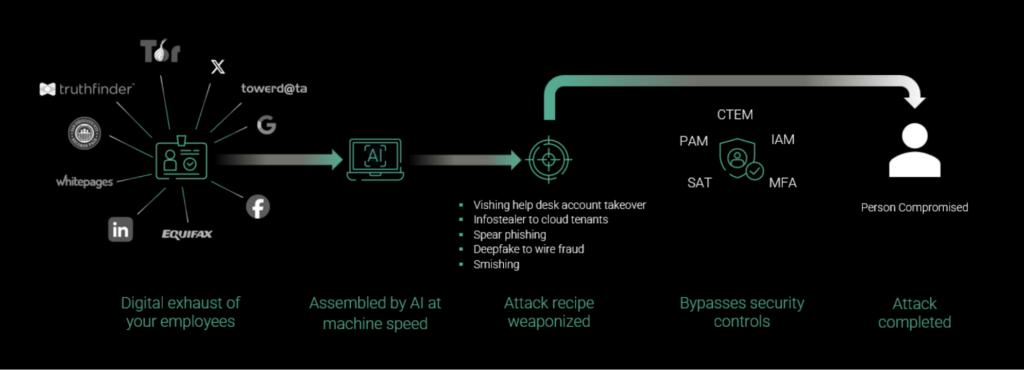
That’s the risk sitting inside this cohort’s media exposure. 97% have a findable phone number, 95% have a date of birth, and 99% appear in at least one breach. None of that detail sits in one place. It’s scattered across social profiles, breach dumps, property records, court filings, and news coverage, and AI-powered collection pulls those scattered pieces into one usable profile. Keynotes, podcast interviews, earnings calls, and conference panels add hours of clean audio and video to the open internet. Current voice-cloning tools need only a short sample to work from. The impersonator doesn’t have to steal anything. Everything required is already published.
4. Breach History And Reused Passwords Keep Old Leaks Working
99% of the 75 leaders appear in at least one data breach, and half the group shows up in 20 or more. Across all 75, that adds up to 1,774 breach appearances total.
What comes out of those breaches keeps circulating. 67 of the 75 leaders have at least one exposed password. 71% reused the same password across more than one breach. That’s exactly what turns a decade-old dump into a working credential-stuffing attempt today. 69% of the cohort also has at least one password with a recognizable, patterned structure. A pattern like that turns a failed replay into a short, educated run of guesses instead of a grind through every combination. Corporate security tools watch the corporate domain. Most of what leaks, and nearly all of what leaks in plain, readable text, rides on personal accounts no corporate tool ever sees. That personal exposure still feeds corporate risk the moment someone reuses the password at work.
What This Means Beyond The AI Industry
VanishID chose this cohort because it should be among the hardest to expose. Senior leaders at the world’s most prominent AI companies have resources and advisors, and several run their own security teams. The finding travels past this one industry anyway. Nothing about the collection depended on the target working in AI. It ran on data broker listings, breach records, and public filings, the same sources any company’s leadership and workforce sit in. And make no mistake, it’s no longer just leadership that are targets for these attacks, because they’re not the only ones with keys to the castle.
MITRE ATT&CK classifies the gathering of this kind of identity information as reconnaissance, technique T1589. MITRE describes it as a step that “cannot be easily mitigated with preventive controls.” The only defense MITRE points to is reducing the data available to attackers in the first place. That’s the exposed identity data problem External Identity Security was built to address.
It starts with finding where that data sits in the open and removing what can come down. What can’t be removed still gets headed off before it can become an attack, through integration with existing security controls that dynamically harden for exposed individuals, for example by forcing a password reset or triggering a help desk process that stops accepting that individual’s exposed details as proof of identity.
The 75 leaders in this report aren’t an outlier. They’re a baseline most companies haven’t measured yet.
The full AI Leadership Exposure Report covers all ten attack categories this exposure enables, from insider recruitment and doxxing to extortion and swatting. Each one ties to a specific statistic or documented case. The report also compares this cohort’s exposure against thousands of other senior executives and lays out what VanishID’s research team recommends doing about it.
Download the full 2026 AI Leadership Exposure Report to see the complete findings.
External Identity Security applies beyond AI leadership, too. VanishID has covered how this same exposure plays out elsewhere, from reconnaissance on your people to help desk impersonation calls. The people building America’s AI infrastructure have become direct targets for the same reason.