

Table of Contents
A senior executive finishes a conference presentation and posts a photo from the event on LinkedIn–harmless enough, it seems.
Within days, threat actors begin mapping publicly available information about that executive, including contact details, speaking schedules, past roles, and company affiliations.
When those fragments are combined, they form a profile that can be used to impersonate leadership, target assistants, or gain insight into strategic business activity.
Corporate espionage is not a relic of Cold War tradecraft. It is an active, growing business risk, and today it increasingly starts with your leadership team’s digital footprint.
When executives are visible, their information is accessible. When their information is accessible, it becomes a weapon in the hands of threat actors who know how to use it.
This guide explains what corporate espionage looks like in the current threat environment, how publicly available executive data enables it, and what organizations can do to protect their leadership before exposure becomes exploitation.
VanishID’s platform is built precisely for this challenge, helping security teams monitor and reduce executive digital footprint exposure on an ongoing basis.
Key Takeaways
- Corporate espionage has shifted from physical infiltration to data-driven intelligence gathering, with executives as the primary target.
- Publicly available information, including contact details, professional history, and social media activity, can be combined into detailed intelligence profiles.
- Threat actors use this data to execute impersonation attacks, social engineering campaigns, and insider recruitment efforts.
- Traditional security controls are not designed to address executive-level exposure, which exists outside the corporate perimeter.
- Reducing and monitoring your leadership team's digital footprint is now a core component of enterprise risk management.
- VanishID's service provides continuous monitoring and digital footprint reduction as ongoing services for executive protection.
Corporate Espionage Explained for Today’s Enterprises

Corporate espionage is the practice of collecting confidential business intelligence without authorization to gain a competitive advantage. In simple terms, it involves gathering information about a company’s leadership, strategy, operations, or intellectual property without the organization’s consent.
The reality today is considerably less dramatic and more dangerous, because it is happening at scale and often without the target organization ever knowing.
Traditionally, corporate espionage was associated with physical infiltration, insider recruitment, or stolen documents. Competitors might attempt to obtain trade secrets through covert access to offices, systems, or internal communications.
Today, the methods have changed. Much of the intelligence used in modern corporate espionage comes from publicly available sources. This includes:
- Professional biographies
- Conference appearances
- Company announcements
- Social media activity
All of these often reveal valuable insights about leadership roles and organizational priorities.
Threat actors collect small pieces of publicly available information and combine them to build detailed intelligence profiles. These profiles can reveal executive networks, decision-making structures, and communication patterns that help threat actors plan impersonation attempts or targeted attacks.
Executives are prime targets in this environment. Senior leaders maintain public visibility, represent the organization at industry events, and communicate with partners, investors, and customers. Each public appearance expands their digital footprint and increases the amount of data available to threat actors.
For modern enterprises, corporate espionage no longer starts with stolen files. It often begins with public executive data and the intelligence that can be extracted from it.
How Threat Actors Use Public Executive Data in Corporate Espionage

Executives leave a large amount of information online as part of their professional roles. Press interviews, conference appearances, leadership bios, and social media activity all contribute to a growing digital footprint.
On its own, each piece of information may appear harmless. When combined, however, these fragments can create a detailed intelligence profile about leadership teams.
Threat actors actively collect and organize this data to better understand how an organization operates and where opportunities for exploitation may exist.
Below are some of the most common types of publicly available executive data used in corporate espionage.
- Personal contact details: Home addresses, personal email addresses, and mobile numbers are frequently listed across data broker databases, public records, and people-search sites. These details are often accurate and updated automatically as records change.
- Professional history and affiliations: Board memberships, past employers, advisory roles, and professional certifications are routinely listed on company websites, LinkedIn, industry directories, and conference archives.
- Social media activity and speaking engagements: Public posts, event appearances, and media interviews reveal travel schedules, key relationships, strategic priorities, and communication style, all of which are useful to someone preparing a targeted approach.
From Fragments to Intelligence Profiles
No single piece of data is particularly revealing. The problem is aggregation. Threat actors systematically combine fragments from multiple sources to build detailed intelligence profiles that reflect an executive’s identity, relationships, habits, and authority within the organization.
This process, sometimes called open-source intelligence gathering or OSINT, requires no technical expertise and no access to protected systems.
Once a profile is assembled, it enables three categories of harm:
- Impersonation: a threat actor poses as the executive or someone they trust, using known details to make the deception convincing.
- Surveillance: the executive’s activities are tracked to identify opportunities, including travel patterns, key meetings, and decision timelines.
- Access escalation: the intelligence is used to manipulate staff, vendors, or partners into granting system access or disclosing sensitive information.
Each path leads directly into the organization.
Common Corporate Espionage Techniques Targeting Leadership
Once threat actors build intelligence profiles around executives, they begin looking for ways to turn that information into access. Leadership roles come with authority, visibility, and trusted relationships inside the organization.
When threat actors exploit those elements, the impact can reach finance teams, assistants, partners, and entire departments.
Below are several common techniques used to target leadership in corporate espionage operations.
Executive Impersonation and Social Engineering
Threat actors frequently impersonate senior leaders to request sensitive information or urgent actions from employees. Using publicly available executive data, they can create convincing messages that appear to come directly from leadership.
These requests might involve financial approvals, document transfers, or access to internal systems. Because the request appears to come from an executive, employees may act quickly without verifying the source.
The business impact can include fraudulent payments, exposure of confidential documents, or disruption of internal operations.
Strategic Phishing Targeting Assistants and Finance Teams
Executives often rely on assistants, operations staff, and finance teams to handle scheduling, communications, and administrative tasks. Threat actors take advantage of this structure by targeting those individuals with carefully crafted messages.
By referencing real meetings, events, or leadership activities gathered from public sources, these messages appear credible and relevant.
Successful phishing attempts can lead to unauthorized access to company accounts, financial systems, or sensitive correspondence.
Competitor Intelligence Gathering Through Scraped Data
Corporate espionage does not always involve direct attacks. In many cases, threat actors collect intelligence by monitoring public executive activity across professional networks, corporate announcements, and industry events.
This information can reveal strategic priorities, potential acquisitions, or emerging partnerships. Competitors can use this intelligence to anticipate market moves or adjust their strategies.
The result is a competitive disadvantage for the targeted organization.
Insider Recruitment Enabled by Executive Profiling
Detailed executive profiles can also expose internal dynamics within an organization. Threat actors may analyze leadership relationships, team structures, and public statements to identify employees who might be vulnerable to recruitment or manipulation.
In some cases, this leads to attempts to recruit insiders who can provide confidential information or access to internal systems.
When insider recruitment succeeds, the long-term consequences can include intellectual property loss, operational disruption, and serious reputational damage.
Business Consequences of Corporate Espionage
The consequences of corporate espionage extend well beyond the immediate incident. Organizations that experience leadership compromise rarely understand the full scope of the damage until months later, when its effects appear in the market, in the boardroom, or in a regulator’s correspondence.
Some of these consequences include:
- Loss of intellectual property and strategic plans: When competitive intelligence is extracted through espionage, the financial impact is often irreversible. Product roadmaps, pricing strategies, acquisition targets, and client relationships are all difficult to rebuild once compromised.
- Regulatory exposure and compliance risk: Depending on the sector, executive compromise can create obligations to report, disclose, or remediate. Organizations operating under frameworks such as SOC 2, HIPAA, or SEC disclosure requirements face compounding risk when a leadership breach is involved.
- Market manipulation and competitive disadvantage: Intelligence about unreleased financial results, merger discussions, or product launches can be used to gain an unfair advantage in competitive bids, negotiations, or public markets. The consequences can include legal action and regulatory scrutiny.
- Long-term reputational damage: Leadership compromise signals to clients, partners, and investors that the organization’s security posture is insufficient. Rebuilding that confidence takes time and resources that most organizations would prefer to invest elsewhere.
These consequences share a common thread: they are largely preventable when executive exposure is identified and addressed before it is weaponized.
How to Prevent Corporate Espionage in Executive Environments
Most organizations invest heavily in network security, endpoint protection, and employee awareness training. These controls are important, but they often miss a critical exposure point: leadership visibility.
Executives operate in highly public roles. They appear at industry events, in media interviews, on investor calls, and through professional networks.
Each appearance adds to their digital footprint, which threat actors can collect and analyze. Traditional security tools rarely monitor how that information is used outside company systems.
To reduce corporate espionage risk, forward-thinking organizations take a proactive approach to managing executive exposure. The following practices help limit the intelligence threat actors can gather about leadership teams.
Monitor Executive Digital Footprints
Organizations should continuously monitor where executive information appears across public sources. This includes professional directories, conference listings, corporate filings, and data broker databases.
When leadership exposure is mapped clearly, security teams can identify where sensitive information is circulating and assess how it could be used to support impersonation or intelligence gathering.
Reduce Publicly Accessible Leadership Data
Not all executive information needs to remain widely available online. Organizations can reduce unnecessary exposure by removing or limiting sensitive details from public records and data broker listings.
Reducing this information helps limit the amount of intelligence threat actors can gather when building profiles around leadership teams.
Detect Early Signs of Impersonation
Corporate espionage often involves impersonation attempts that target assistants, finance teams, or other trusted contacts. Monitoring signals such as lookalike domains, suspicious communications, or abnormal requests can help organizations detect these attempts early.
Early detection allows security teams to respond before sensitive information or financial assets are compromised.
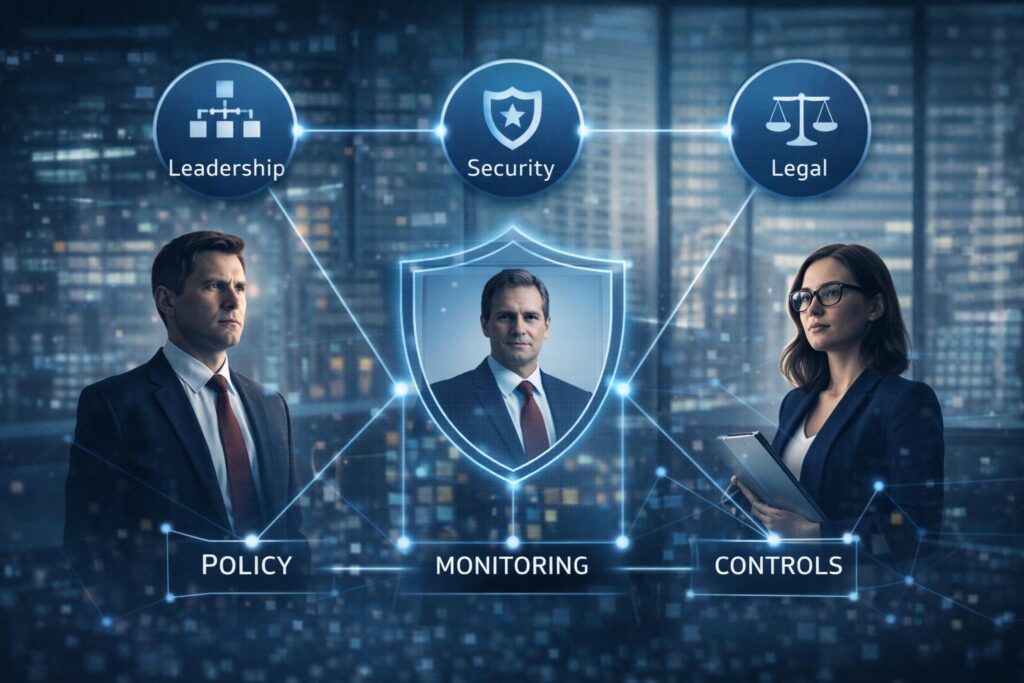
Strengthen Cross-Team Awareness
Protecting executives requires coordination between security teams, legal departments, communications teams, and leadership staff. Each group plays a role in managing how executive information appears publicly and how suspicious activity is handled.
When these teams work together, organizations gain a clearer view of leadership exposure and the risks tied to it.
Corporate Espionage Protection Requires Executive-Specific Monitoring
Executives are not just high-value employees. They are public figures within their industries, and that visibility creates a category of risk that standard employee security programs are not designed to address.
Corporate espionage protection for the C-suite requires monitoring beyond breach databases. It requires understanding how executive information appears across public sources, where that data is aggregated, and whether it is being used in ways that suggest targeting activity.
This includes tracking contact details, professional profiles, event participation, and other publicly available records that contribute to leadership digital footprints.
Traditional monitoring tools focus on compromised credentials or suspicious login activity. While those controls are important, they rarely address how publicly available leadership data can be used to build intelligence profiles around executives.
VanishID’s platform is designed specifically to address this challenge. As a centralized service for monitoring leadership exposure, it tracks executive digital footprints across public data sources, identifies records that increase risk, and supports ongoing data broker removal services as a continuous process rather than a one-time effort.
Over time, this approach helps organizations maintain a cleaner and more defensible executive profile.
Security teams that integrate executive monitoring into their operations gain clearer visibility into leadership exposure. This allows for better risk prioritization, stronger board-level reporting, and faster response when signs of targeting begin to appear.
Integrating Executive Espionage Risk into Enterprise Security Strategy
Corporate espionage targeting leadership should not be treated as an isolated cybersecurity issue. It is an enterprise risk that affects strategic planning, governance, and long-term business resilience.
When executive exposure is monitored consistently, organizations gain intelligence that supports better decision-making across multiple teams.
Integrating executive monitoring into enterprise security programs helps organizations move from reactive defense to proactive risk management. It also ensures leadership exposure is addressed alongside other security priorities.
Below are several ways organizations can integrate executive espionage risk into broader security strategy.
Align Executive Monitoring with Enterprise Risk Management
Executive digital footprints should be monitored as part of the organization’s broader risk management framework. When leadership exposure is tracked alongside operational and financial risks, security teams gain a more complete view of potential threats.
This alignment helps leadership teams understand how executive exposure can influence business risk.
Support Board-Level Reporting
Boards increasingly expect clear visibility into emerging security risks. Monitoring executive exposure provides security teams with actionable intelligence that can be included in governance reporting.
This information helps boards understand how leadership visibility affects the organization’s risk profile.
Encourage Cross-Team Collaboration
Managing executive exposure requires collaboration between several departments, including:
- Security teams monitoring potential targeting signals
- Legal teams reviewing regulatory and governance implications
- Communications teams managing public visibility of leadership
- Executive staff coordinating travel, events, and public engagements
When these groups share insights, organizations gain a clearer understanding of how leadership exposure develops and how it should be managed.
Protecting Leadership Is Protecting the Business
Corporate espionage rarely begins with a dramatic breach. In many cases, it starts with publicly available executive data that threat actors collect and analyze over time. When leadership information appears across directories, professional networks, event listings, and public records, it becomes easier to build intelligence profiles that support impersonation or targeted attacks.
Protecting leadership, therefore, requires more than traditional security controls. Organizations need visibility into how executive digital footprints appear across public sources and how that information can be used.
VanishID’s solutions help organizations monitor leadership exposure and reduce executive digital footprints through continuous services.
Explore our executive monitoring and digital protection plans to strengthen your organization’s defense against corporate espionage.